Rumour and false report
Henry IV, Part 2Rumour and false report is presented as an active force in the play’s political world: it travels ahead of events, turns conjecture into apparent knowledge, and can make uncertainty itself a source of danger. Its opening appearance at Warkworth gives that process a body—painted with tongues—and frames the reports of battle that follow as both urgent and unstable.
Personification and Method
The play introduces Rumour before the action at Warkworth, entering as a figure whose many tongues make visible the spread of stories from speaker to speaker. Rumour describes those tongues as carrying continual slanders and speaking in every language, stuffing listeners’ ears with false reports. The image is not of a single mistaken message but of repeated transmission: the same force can reach many communities and make uncertain claims sound widely confirmed.
Rumour’s account of its own method is notably fragile. It likens itself to a pipe blown by surmises, jealousies, and conjectures, and stresses how easily that pipe can be stopped. The comparison joins reach to vulnerability: rumours travel because people repeat them, yet their apparent force does not guarantee their truth. The opening makes that contradiction part of the play’s design. Rumour can fill public hearing while remaining answerable to no reliable witness.
Reports from Shrewsbury
At Warkworth, Rumour claims to run ahead of King Henry IV’s victory at Shrewsbury, where Harry Percy and his troops have been beaten. But the account also carries a more alarming report: that King Henry IV bowed his anointed head almost to death before Douglas. The reports place victory and apparent royal peril within the same stream of news. Rumour’s speed does not produce a settled account; instead, it brings incompatible impressions of the battle to listeners who cannot yet verify them.
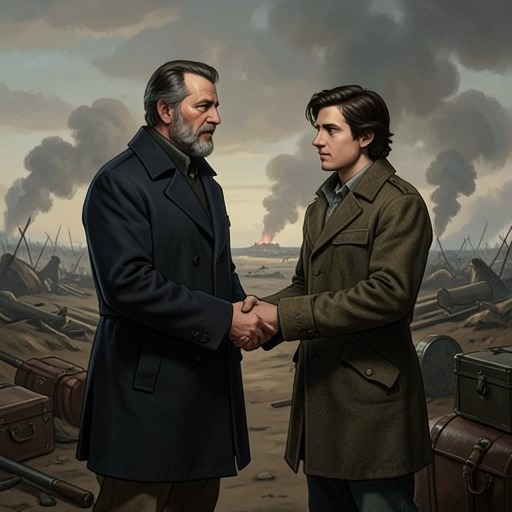
The messengers who arrive afterward give that uncertainty a human route. Travers explains that Sir John Umfrevile turned him back with joyful tidings, then outrode him because he had a better horse. The detail makes the transmission of news a race in which speed and circumstance affect who reaches the listeners first. Morton, by contrast, says he ran from Shrewsbury, where death had taken its most frightening form for their party. His arrival shifts the emotional weight of the scene from Travers’s joyful report to the fear and losses associated with the battlefield. The play thus distinguishes reports not only by their content but by who carries them, how they travel, and what emotional force they bring.
Fear, Numbers, and Political Judgment
Rumour’s distortions recur beyond Warkworth. When a figure of fifty thousand is given for the rebel force, Warwick rejects the estimate and observes that Rumour doubles the numbers of those feared, as an echo enlarges a voice. His comparison identifies fear as a condition that changes information in transmission: the number grows not through a verified count but through the listeners’ apprehension of their opponents. Warwick’s correction offers a counterweight to the opening image, though his statement also shows that the court must actively judge reports rather than simply receive them.
The play places this problem within a broader concern with how accounts of the past shape expectations. Reflecting on the former friendship of Richard II and the Earl of Northumberland, Warwick turns to the way individual lives can figure the character of their times. That retrospective perspective differs from Rumour’s hurried, unsettled announcements: it looks for patterns across years rather than treating the latest report as a complete explanation. The contrast suggests that political understanding requires more than speed; it also requires comparison and judgment.
Defeat and the Limits of Report
Later news states that the Earl of Northumberland and Lord Bardolph, leading a substantial force of English and Scots, have been overthrown by the sheriff of Yorkshire. The report gives a definite outcome to a later military conflict, but its appearance also recalls the play’s earlier warnings about how news reaches its audience. Rumour’s opening claim to race ahead of victory is not the same as a reliable account of events; the play repeatedly makes listeners confront the gap between what is reported, how it is received, and what can be established.
Rumour therefore functions as more than an image for lying. Its painted tongues, its pipe of conjecture, Travers’s faster rival messenger, Morton’s fearful testimony, and Warwick’s correction of inflated numbers form a sustained inquiry into political knowledge under pressure. Reports can move faster than verification, acquire force from fear, and alter the sense of a battle before its consequences are fully understood. The play’s recurring attention to who speaks and how a message travels makes the circulation of information part of the conflict itself.